Lucent Biosphere
A model of maturity.
The Lucent Biosphere is a metacognitive maturity model for evaluating intelligence-embedded systems across computational, operational, organizational, and institutional levels.
It maps how systems, organizations, and institutions develop the context, governance, and evidence required for increasingly capable systems to remain governable.
Operating Environment
More than a technical system.
Governable systems do not emerge from engineering alone. They depend on the relationships among technical capability, institutional authority, shared meaning, human judgment, and usable evidence.
Lucent brings those relationships into one operating environment. Research informs architecture. Architecture creates evidence. Evidence enables evaluation, institutional learning, and future standards.
Human Factors
Behavior, meaning, and interpretation.
Governance
Rules, accountability, and institutions.
Systems
Technical environments and machine behavior.
Research environment
Lucent
Lucent builds research as a layered environment for systems, governance, and human factors.
Clopen Institutional Design
Open to possibility. Closed to drift.
Clopen Institutional Design is a Lucent-developed approach for governing where emergence is permitted and what must hold. Systems remain open to legitimate variation while preserving a governed core of authority, semantics, obligations, procedures, evidence, and accountability.
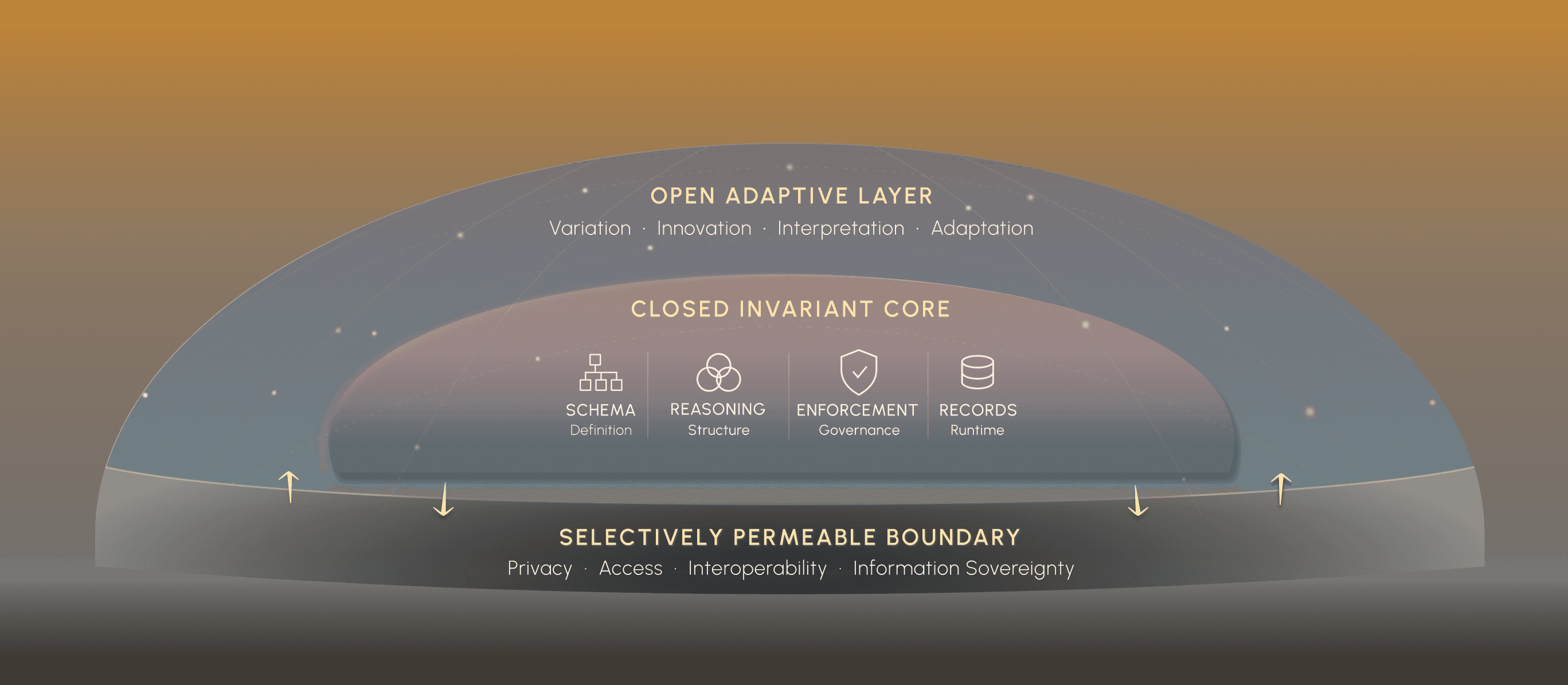
Open where variation creates value.
Innovation, experimentation, interpretation, adaptation, and proprietary differentiation remain possible across changing environments and institutional needs.
Closed where legitimacy is at stake.
Authority, meaning, obligation, procedure, evidence, and accountability cannot change silently without changing the legitimacy of the system itself.
Thesis
Governability requires infrastructure.
Intelligence-embedded systems become governable when institutional intent, reasoning, and evidence are structured as computational components of the system itself.
Intent
Reasoning
Evidence
Research claim
Governance becomes operational when context is computationally available at runtime.
This is Metacognitive Compute™.
Research Orientation
What disciplines inform the work.
Lucent draws from systems research, cybernetics, information ethics, human factors, technical and professional communication, organizational studies, governance, and institutional design to study intelligence-embedded systems across computational, operational, organizational, and institutional levels of abstraction.
Core Framework
Why STEAMS structures the work.
STEAMS defines the minimum set of disciplines required to design systems that are both technically capable and institutionally accountable.
Science & Social Science
Foundations across natural, cognitive, and social systems ensure alignment with human behavior, institutions, and real-world conditions.
Technology
The computational layer, including artificial intelligence, robotics, and protocol design.
Engineering
Methods for reliability, control, and interface implementation.
Art & Humanities
Design, narrative, ethics, and cultural context shape how systems are experienced, interpreted, and governed.
Mathematics
Formal structures including statistics, trust metrics, drift measures, and system invariants.
Systems
Integration, feedback loops, and governance bind technical, human, and institutional layers into a into a coherent, legible, and governable whole.
STEAMS
Disciplines assembling into a governable whole.
Framework Rationale
A complete system, by design.
Without an integrated framework, system design fragments across disciplines. Engineers optimize performance, designers optimize experience, and regulators optimize compliance.
STEAMS replaces that fragmentation with a shared structure for developing systems that can be interpreted, traced, evaluated, and governed as coherent institutional objects across the full path from intent to outcome — and that can produce the evidence required to support trust.
Research Questions
What the research is testing.
Lucent evaluates how structured context, governance artifacts, and traceability affect system performance, human-system interaction — including human-machine interfaces (HMI) and human-robot interaction (HRI) — daily operations, and institutional outcomes across field deployments.
Do structured governance artifacts reduce ambiguity, rework, and decision latency during field deployment and daily operations?
Can divergence between institutional intent and observed system behavior be detected, interpreted, and corrected before it becomes operational failure?
How do structured context and runtime evidence affect system performance, human-system interaction, escalation behavior, and operational reliability?
Do governance mechanisms and structured records improve information maturity, institutional readiness, auditability, and accountable operation?
Can governance artifacts move across systems, teams, and institutional environments without losing meaning, authority, or operational usefulness?
Under what conditions do transparency, traceability, and reviewable evidence support justified public confidence in intelligence-embedded systems?
Research Journey
How the research progresses.
Research and development advance through a staged sequence connecting intellectual property, pilot environments, validation, dissertation work, and future deployment.
Research progression
Research advances through staged validation and deployment.
Research Method
How claims are evaluated.
Lucent evaluates claims through controlled pilots, artifact analysis, and longitudinal observation, comparing system conditions before and after structured-context interventions.
Compare system conditions before and after structured-context or schema intervention.
Evaluate documentation quality, provenance, structure, and intent-to-outcome traceability.
Track changes in decision latency, rework, alignment, evidence readiness, and institutional confidence.
Knowledge Cycle
How findings return to architecture.
Findings return to the architecture as refined definitions, schemas, controls, evidence requirements, and governance mechanisms.
Develop and test claims about governability, context, and system behavior.
Translate validated findings into operational structures, controls, and system components.
Use runtime evidence and observed outcomes to refine future research and governance decisions.
Publication and Collaboration
Making the work available for scrutiny.
Publication translates system behavior into shared knowledge through technical papers, visual briefings, governance frameworks, field manuals, and validated case studies.